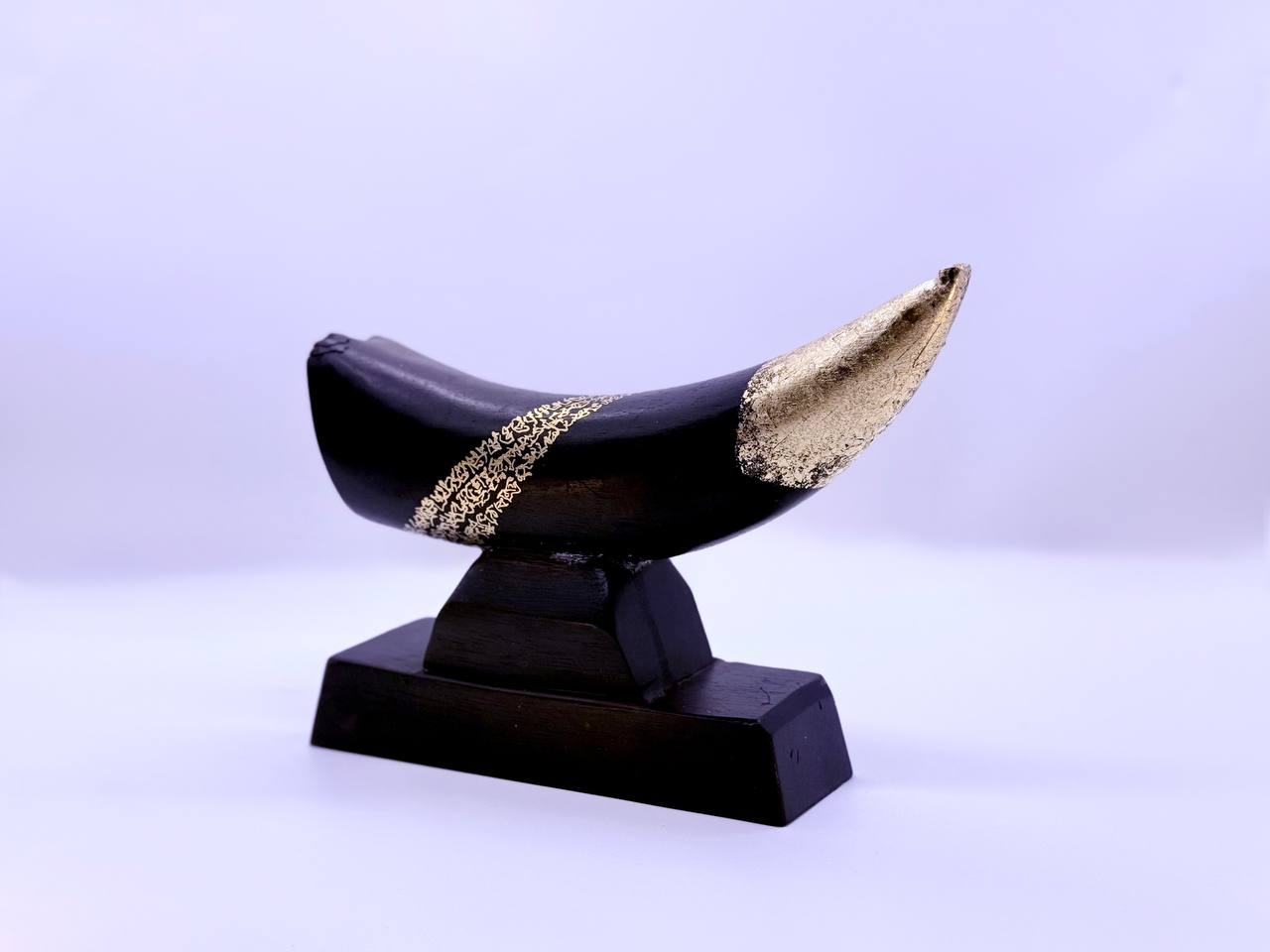
Gold leaf on a white ground reads one way. Gold leaf on a black ground reads another. The substrate changes the work at every distance. It is not a backing. It is a participant.
From across a room the black ground reads as solid mass. It does not reflect. It absorbs everything that reaches it. Against that absorption the gold becomes pure signal. The contrast is not decorative. It is structural. The black holds the gold in place optically. The gold becomes mark, pattern, gesture against a field that does not compete. At this distance the work reads as emblematic. The ground recedes and the gold advances. The relationship is binary and deliberate.
Closer, the reading shifts. The black ground is no longer a flat void. It becomes surface with texture, with tooth, with the marks of its preparation. The gold is no longer pure signal. It becomes material. You see the edge of each leaf. You see adhesive gripping one particle and skipping the next. The black ground shows through gaps in the application. It becomes the between, the negative space that gives the gold its shape. At this distance the work reads as made. You see the hand. You see the decision.
This shift from distance reading to close reading is not accidental. It is built into the choice of ground. A white or light ground would reflect back through thin applications. It would soften the contrast at distance and flatten the surface up close. The black ground does the opposite. It amplifies contrast at range and discloses fabrication up close. The viewer moves through these states. The work changes as they approach. That change is part of the experience of the surface.
The collector who understands this distinction reads the work differently. They know the surface is not a single statement. It is a layered negotiation between ground and leaf, between absorption and reflection, between the signal across the room and the texture within arm's reach. The black ground makes this negotiation visible. It is not hiding. It is working.
These material choices are easiest to read in finished work: Solace and Saguaro Moon apply this thinking in gold leaf on a black ground. If you would like a piece made to your own scale and setting, you can commission a gold-leaf-on-black artwork.