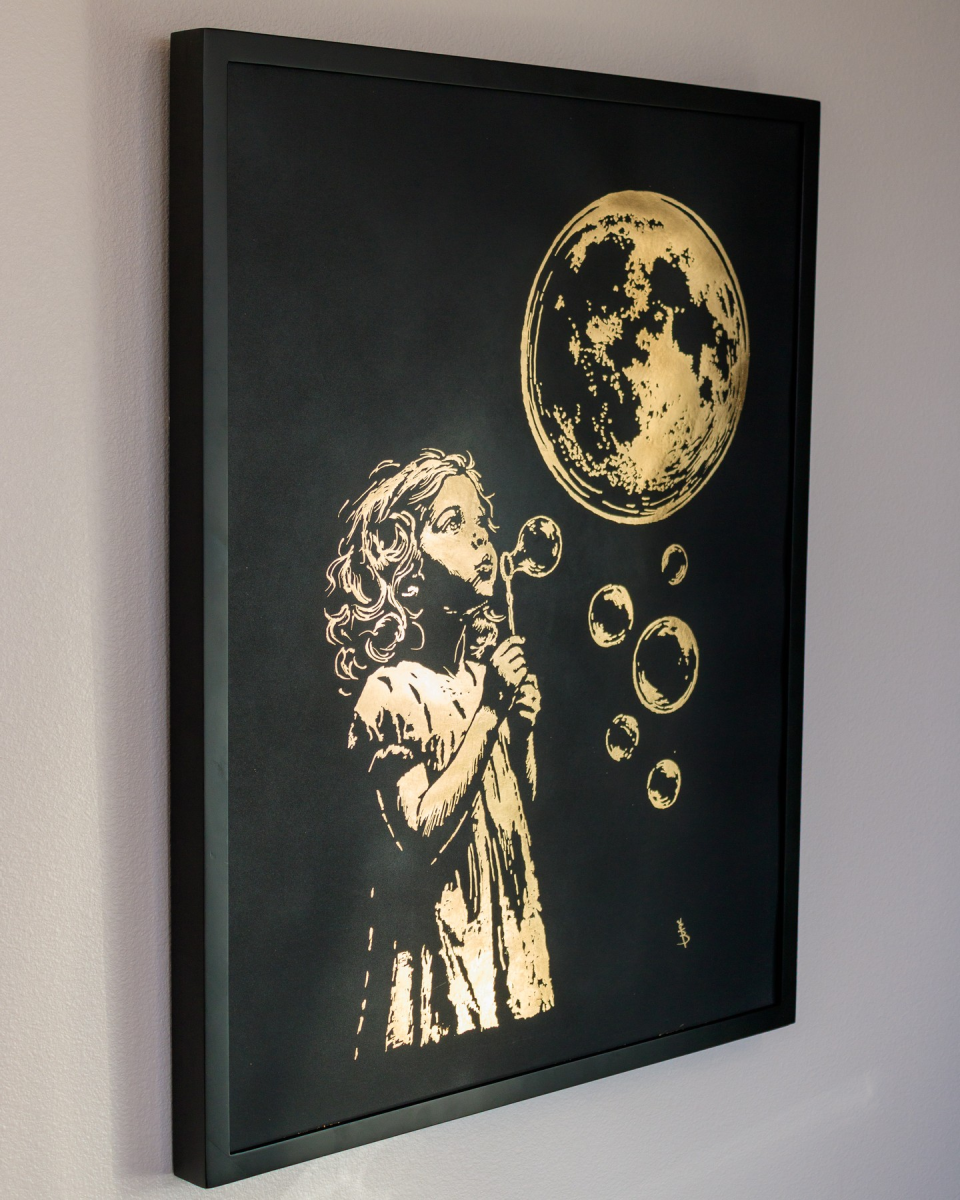
The size of a gold leaf fragment is a compositional act. Before the leaf meets the black ground, the artist decides how much surface each piece will claim and how the seams between pieces will read. That decision controls the visual weight of the field.
Smaller fragments produce a denser seam network. The joins between pieces accumulate, creating a surface that reads as more broken, more constructed. The eye registers each edge, each transition. The repair burden increases because every seam is a potential lift point. A small fragment has more edges relative to its surface area, and more edges means more points that demand secure adhesion. The rhythm becomes quicker, tighter. The ground shows through more frequently, breaking the gold field into smaller intervals.
Larger fragments invert every one of these outcomes. Fewer seams mean fewer visual interruptions. The gold surface reads as a broader, more continuous field. The repair burden drops because each piece has more bonded surface area relative to its edge length. The rhythm opens up. The eye moves across larger uninterrupted planes of gold before encountering a seam. This produces a different kind of authority. Not the authority of precision workmanship, many small pieces carefully placed, but the authority of surface mass. Gold claiming territory in larger strokes.
On a black ground, these differences register with particular clarity. Black is not a neutral substrate. It functions as the visible counterpoint at every seam. With small fragments, the black appears frequently, punctuating the gold surface like a rhythmic pattern. With large fragments, the black recedes into the background, asserting itself only at widely spaced intervals. The artist controls how often the ground participates in the reading.
Neither approach is superior. They produce different visual effects and demand different handling. The decision is practical and compositional at once. Fragment size determines how much the seams will participate in the surface, how much repair work will be needed, and what kind of rhythm the gold field will carry against black. That is the mechanics of surface authority. Not a style applied after the fact, but a choice made before the first piece is laid.
These material choices are easiest to read in finished work: Les Trois Chaplin and Voyage apply this thinking in gold leaf on a black ground. If you would like a piece made to your own scale and setting, you can commission a gold-leaf-on-black artwork.