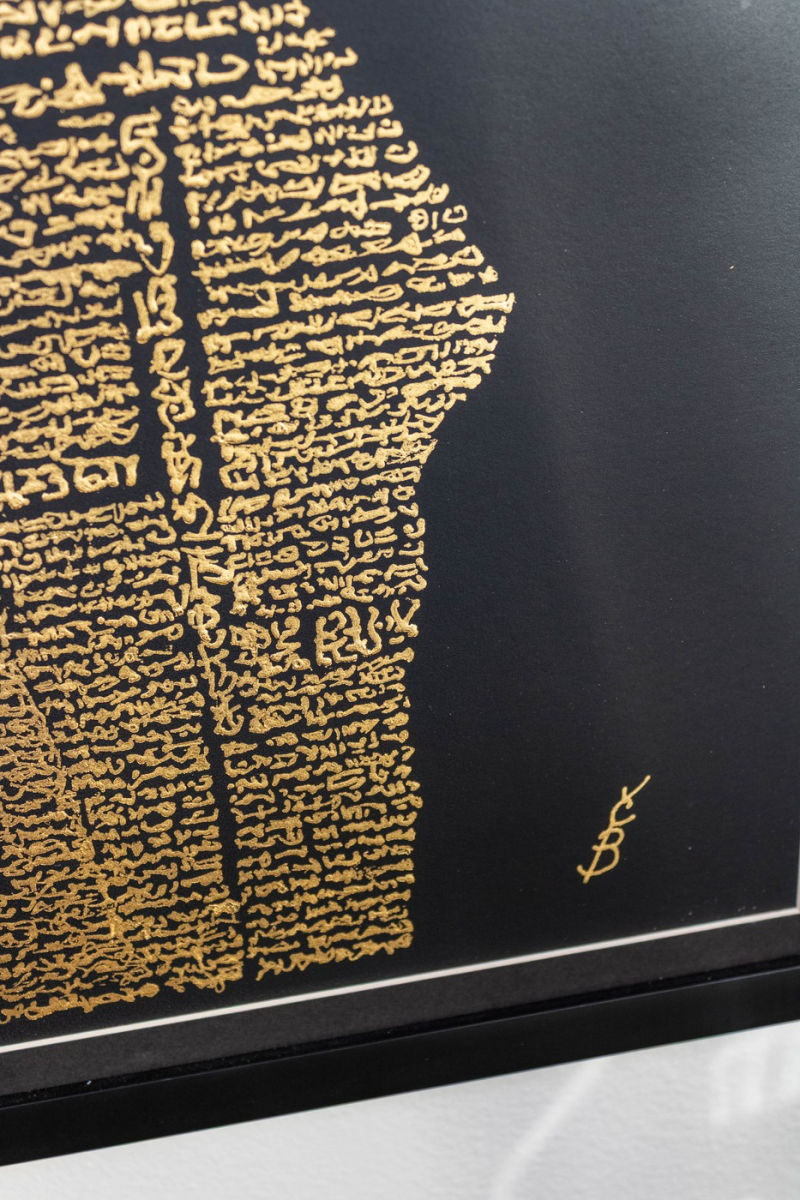
Gold leaf applied to a panel creates a continuous reflective plane. Light hits that plane and returns evenly, giving gold its characteristic glow. The surface functions as a single optical unit. It reads as a field of light, not as material with interior depth.
An engraved or scratched line changes this completely. The tool displaces gold along a furrow. That furrow has walls, a floor, and edges. Each of these surfaces catches and throws light at a different angle from the polished field around it. What was a uniform reflective plane becomes a landscape of microsurfaces, each with its own optical behavior.
This is not ornament. Ornament sits on top of a surface. It adds. An incised line removes. The removal is the point. The gold has been displaced, not covered. What remains is physical evidence of a gesture, written into the material itself.
In practice, this means the line reads as structure rather than image. A viewer does not see a drawing on top of gold. They see gold that has been reconfigured. The line is not an illustration of something. It is an event in the material. This is the difference between applying a mark and cutting one.
The behavior of light along an incised line changes with the width, depth, and angle of the tool. A broad, shallow cut produces a soft highlight along one edge and a shadow along the other. A narrow deep scratch produces a bright line that tracks the motion of the tool. Different tools produce different structures. The choice of tool is a material decision, not a stylistic one.
When multiple incised lines are placed close together, their edges interact. Adjacent furrows create controlled interference patterns in the returning light. The gold appears to shimmer along the grain of the marks. This shimmer is not a coating or a treatment. It is the sum of thousands of microedges reflecting light from slightly different angles.
For a collector, this matters because the work changes with the light. A polished gold surface reads the same in most lighting conditions. An incised gold surface reads differently from every angle, under every light source. The work is never the same object twice. The marks create this instability.
The decision to engrave or scratch gilded gold is a decision to make the surface legible as structure. The gold is not there to be looked at. It is there to be read.
These material choices are easiest to read in finished work: Katagami Courier and Savings apply this thinking in gold leaf on a black ground. If you would like a piece made to your own scale and setting, you can commission a gold-leaf-on-black artwork.