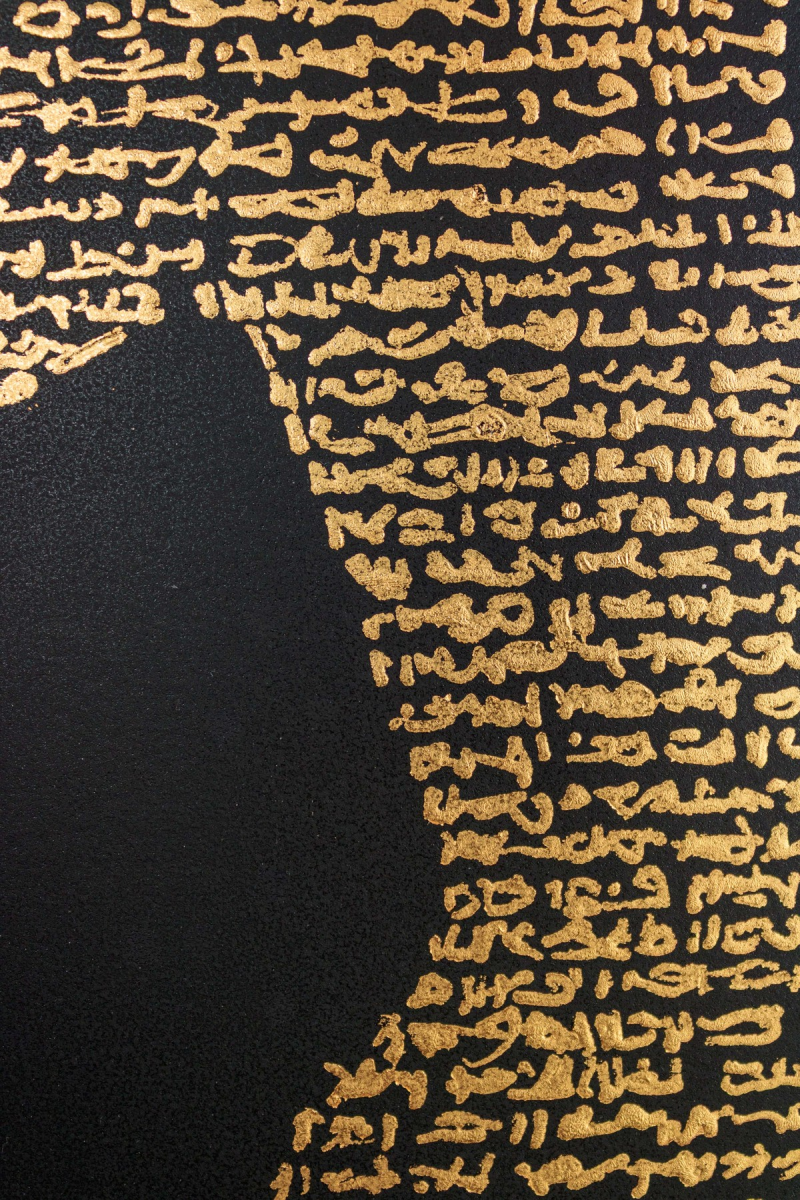
Auruscript began as private notation: invented glyphs that can carry pressure, rhythm, and intent without becoming readable language. On a black surface, those marks do more than suggest writing. They become visual mass, and that mass changes with density.
The spacing between glyphs is not a minor detail. It decides how the surface is read.
Tightly packed Auruscript can register from across a room as a continuous gold field. Individual marks collapse into texture. The eye does not parse symbols at that distance. It registers weight, presence, and material concentration. The black ground is reduced to interruption, visible at the edges and in the small intervals between marks. What looks unified from a distance is built from repeated hand decisions.
Open script behaves differently. Each mark stands apart, separated by enough black ground that the eye must travel between them. The pace slows. A sparse line can carry the memory of notation without offering a text to decode. The viewer stays with form, spacing, pressure, and reflection rather than translation.
This is the value of invented script in a gold on black work. It lets the surface operate at several distances at once. From across a room, the gold reads as field. Closer in, pattern appears. At arm's length, the field breaks into individual marks, each one held in relation to its neighbor and to the surrounding black.
Density becomes a way to control time. Tight glyphs move the eye quickly across the surface. Wider spacing creates pauses. A dense passage can feel almost architectural, while an open passage gives the black ground authority. Neither condition is stronger by default. The composition decides which one leads.
For a collector, this matters because the work is not exhausted in a single viewing. Morning light may favor the dense zones. Evening may pull attention toward the dark intervals. Movement through the room changes the balance again. The piece asks to be read repeatedly, but never as text.
That is the point of Auruscript. Not secrecy. Not decoration. It is a disciplined way to control how fast a surface is seen, how much gold reaches the eye, and how long the viewer remains inside the work.
These material choices are easiest to read in finished work: Cosmic Coil and Apex apply this thinking in gold leaf on a black ground. If you would like a piece made to your own scale and setting, you can commission a gold-leaf-on-black artwork.