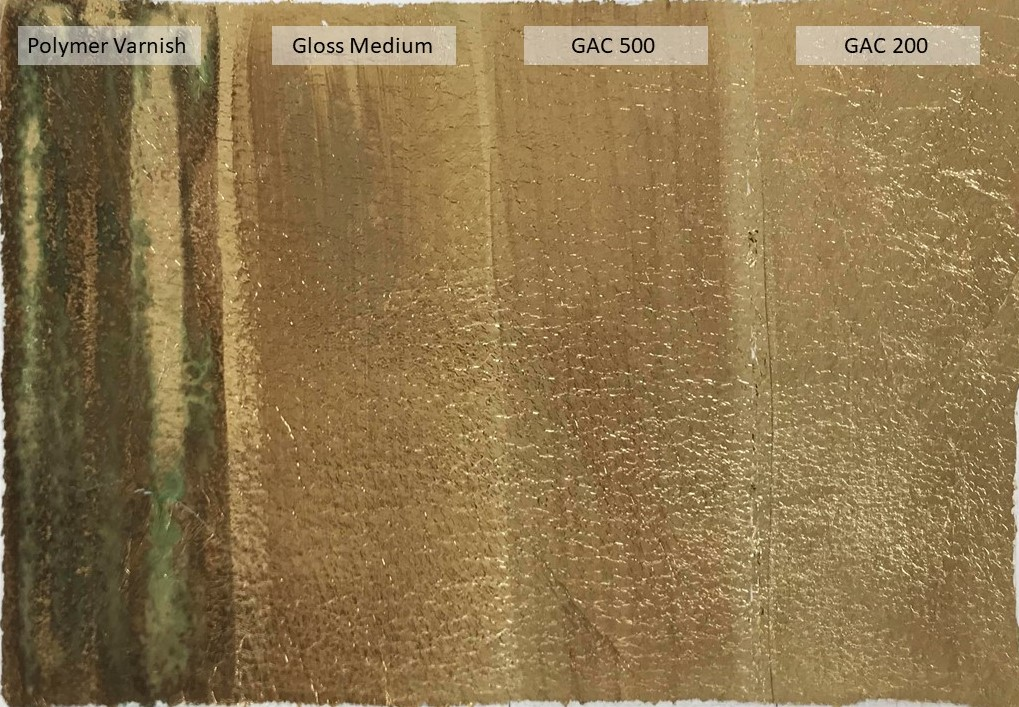
Gold-toned surfaces present a precise studio problem: how do you protect a surface without reducing the reason it works?
The standard answer is a clear coat. A uniform barrier. It can seal the surface, but the cost often appears only after the coating has settled. What was a lively, shifting gold field reads as a single tone under glass. The micro-variation that gave the surface its energy flattens into a uniform gloss or an even matte. The work is preserved materially, but its visual character has been negotiated downward.
That bargain between protection and presence is rarely examined carefully enough. Most discussions focus on which product to use, as if the answer were simply a matter of finding the right container. But the problem runs deeper than chemistry. A protective layer sits between the surface and the eye. It changes how light enters, leaves, and breaks across texture. That is not a neutral act.
The real question is whether protection must behave like a film placed on top, or whether it can be made to cooperate with the surface below it. When the approach works with texture, relief, and tonal variation rather than sealing them under a uniform sheet, the contrast survives. The gold stays articulate. The movement between passages remains visible because the coating follows the surface instead of overriding it.
This is not only a technical decision. It is a visual one. A topcoat can make a surface more durable while making it less convincing. It can also preserve the object while reducing the optical tension that made the object worth preserving.
For works on panel, the considerations are different than for works on paper, and the expectations should be different too. The substrate informs how protection behaves. A method that flattens one material might preserve the depth of another. There is no universal answer, which is precisely why the question deserves a more careful look than a product label provides.
What matters is that the decision is made deliberately, with an understanding of the trade. The point of protecting gold is to preserve its visual intelligence: a surface that catches light, shifts under movement, and rewards attention. Not to stabilize a quieter version of itself.
These material choices are easiest to read in finished work: Loopwork and Between Sentences apply this thinking in gold leaf on a black ground. If you would like a piece made to your own scale and setting, you can commission a gold-leaf-on-black artwork.